
The Changing Qualification Pathway for Lawyers (SQE & QWE)
The introduction of the SQE and QWE has fundamentally changed how solicitors enter the profession. Discover why qualification is now just one milestone within a much longer journey towards professional competence, practice readiness and continuous career development.
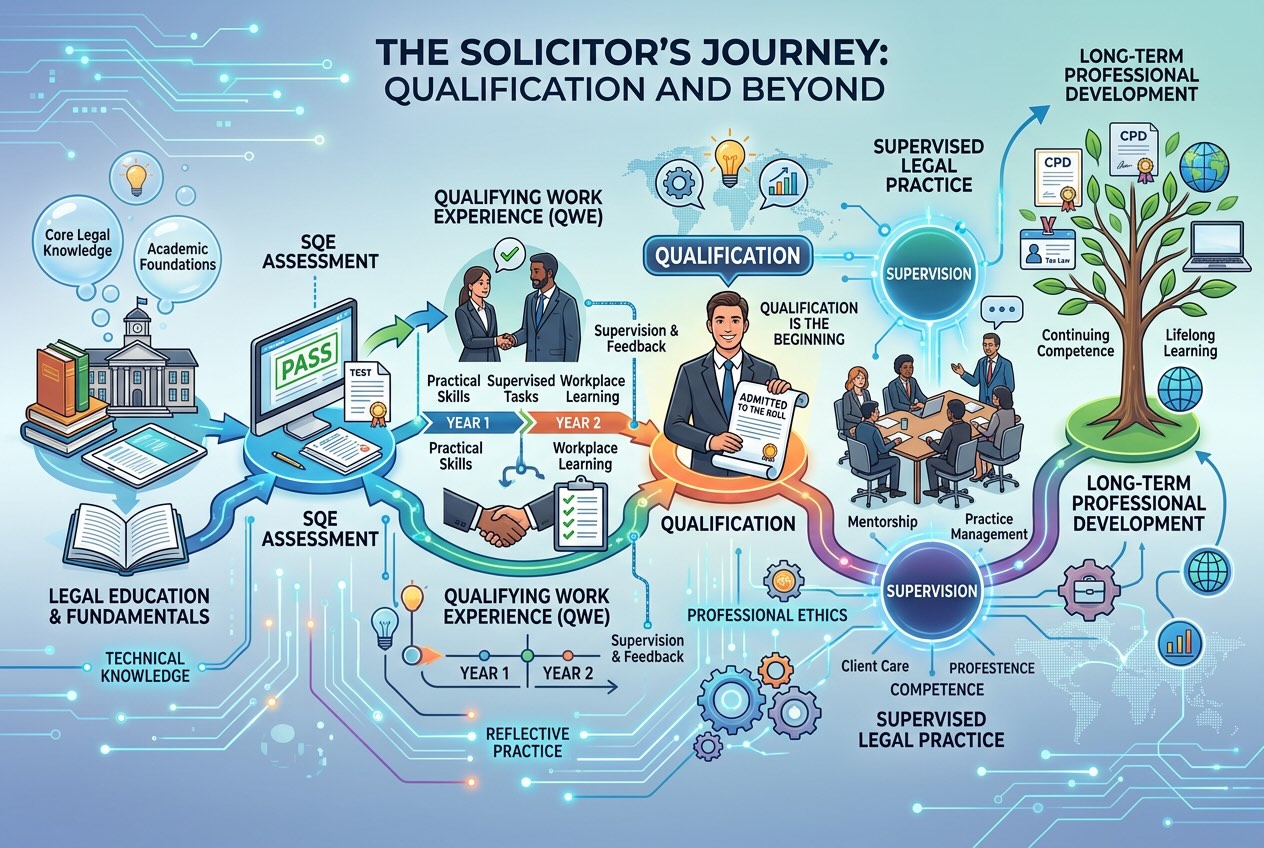
Introduction
The route to qualification as a solicitor in England and Wales has undergone its most significant transformation in a generation.
The introduction of the Solicitors Qualifying Examination (SQE) and Qualifying Work Experience (QWE) has changed not only how aspiring solicitors qualify, but also how law firms think about developing future professionals.
Historically, qualification followed a relatively linear pathway. Academic study led to vocational training. The training contract provided structured workplace experience and qualification marked the transition into professional practice.
The SQE has introduced a more flexible model. Candidates can gain qualifying work experience in a wider range of settings, follow different educational routes and demonstrate competence through a centralised assessment process.
This flexibility creates significant opportunities. It also introduces new responsibilities for employers, supervisors and Learning & Development teams. Perhaps most importantly, it reinforces an important principle that qualification is no longer the end of professional development, but it is the beginning of a career built upon continual learning, supervision and professional growth.
Understanding the SQE
The SQE establishes a consistent national assessment for aspiring solicitors.
Rather than qualifying through multiple educational pathways with different assessments, candidates now demonstrate that they have met a common standard of legal knowledge and practical legal skills.
The SQE consists of two stages.
SQE1 assesses functioning legal knowledge across a broad range of legal subjects.
SQE2 assesses practical legal skills including:
- client interviewing;
- advocacy;
- legal research;
- legal writing;
- drafting;
- case and matter analysis.
Together these assessments establish a consistent threshold for admission to the profession.
The Importance of QWE
Alongside the SQE sits QWE. QWE recognises that professional capability develops most effectively through meaningful workplace experience and unlike the traditional training contract, QWE offers greater flexibility.
Experience may be gained across multiple organisations, different legal environments and a wider variety of professional roles. However, flexibility should not be confused with reduced expectations.
The purpose of QWE is to expose aspiring solicitors to genuine legal work while supporting the development of professional judgement, ethical behaviour and workplace capability. The quality of that experience remains critically important.
Qualification Is Only the Beginning
Passing the SQE demonstrates that an individual has met the entry standard for the profession.
It does not mean that every newly qualified solicitor has fully developed the confidence, judgement and professional maturity associated with experienced practitioners.
Those qualities continue developing through:
- supervised practice;
- workplace experience;
- reflective learning;
- coaching;
- mentoring;
- continual professional development.
Law firms therefore play an essential role in helping newly qualified solicitors bridge the gap between qualification and long-term professional capability.
Understanding Practice Readiness
One of the most important concepts emerging alongside the SQE is practice readiness.
Practice readiness extends beyond examination performance.
It reflects an individual’s ability to apply legal knowledge effectively within real professional environments.
Practice-ready solicitors demonstrate:
- sound professional judgement;
- effective communication;
- ethical decision-making;
- client awareness;
- resilience;
- commercial understanding;
- collaborative working.
These qualities develop progressively through experience rather than assessment alone.
The Role of Law Firms
The flexibility introduced by the SQE increases the importance of organisational learning.
Employers should provide:
- structured supervision;
- meaningful feedback;
- progressive responsibility;
- reflective practice;
- professional skills development;
- opportunities for continual learning.
Rather than assuming qualification equates to professional readiness, firms should actively support the transition into confident professional practice.
Supporting Early-Career Lawyers
The first years following qualification often represent the steepest learning curve within a solicitor’s career.
Newly qualified lawyers begin managing greater responsibility while continuing to develop:
- professional judgement;
- client relationships;
- commercial awareness;
- confidence;
- leadership behaviours;
- decision-making.
Organisations that invest in structured early-career development create stronger professionals while improving retention and client service.
Professional Skills Become Increasingly Important
The SQE assesses practical legal skills.
However, many of the capabilities that distinguish outstanding solicitors continue developing long after qualification.
These include:
- communication;
- leadership;
- teamwork;
- negotiation;
- supervision;
- adaptability;
- emotional intelligence.
Professional skills become increasingly valuable as careers progress.
Learning should therefore continue well beyond qualification.
Supervision and Reflection
Effective supervision transforms workplace experience into professional learning.
Constructive discussions encourage newly qualified solicitors to:
- reflect upon decisions;
- identify development needs;
- build confidence;
- strengthen judgement;
- learn from experience.
Reflection converts everyday work into continual professional development.
Together, supervision and reflection form the foundation of long-term capability.
Building Careers Rather Than Completing Qualifications
One of the greatest opportunities created by the SQE is the encouragement of lifelong professional development.
Qualification becomes one milestone within a broader professional journey.
Organisations increasingly focus upon:
- capability development;
- professional performance;
- leadership potential;
- continual competence;
- organisational learning.
This broader perspective benefits both individuals and employers.
Preparing for the Future
The legal profession will continue evolving.
Technology, changing client expectations and increasing professional complexity will require solicitors to learn continuously throughout their careers.
The SQE provides a strong foundation.
However, future success will depend upon organisations capable of developing professionals beyond qualification through effective supervision, structured workplace learning and continual professional development.
Practice readiness will increasingly become a strategic organisational objective rather than an individual aspiration.
Key Takeaways
- The SQE and QWE have fundamentally changed the route to qualification as a solicitor.
- Qualification represents the beginning rather than the end of professional development.
- Practice readiness depends upon workplace learning, supervision and continual capability development.
- Law firms play a critical role in supporting newly qualified solicitors.
- Professional skills continue developing throughout a solicitor’s career.
Conclusion
The introduction of the SQE and QWE marks an important evolution in legal education.
By creating greater flexibility while maintaining consistent professional standards, the new qualification pathway encourages broader access to the profession and stronger workplace learning.
However, qualification alone cannot create experienced professionals. The capabilities that define excellent solicitors—judgement, confidence, communication, leadership and professional maturity—develop over time through supervised practice and continual learning.
For law firms, the challenge is no longer simply supporting qualification It is creating environments where newly qualified solicitors continue developing into trusted advisers, effective colleagues and future leaders.
Ultimately, the changing qualification pathway reminds us that becoming a solicitor is not the conclusion of professional development. It is the beginning of a lifelong commitment to learning, competence and professional excellence.
CONTINUE READING
Read Other Articles in This Series
Previous Article

How Law Firms Are Responding to the SQE Skills Gap
Next Article
Early Findings from the SQE: What Firms Are Seeing in Practice
Explore Related Topics

Measuring Strategic Capability: Turning Organisational Insight into Executive Decision-Making
Recommended Next Step
SQE Practice Readiness: What the Data Means for Law Firms
